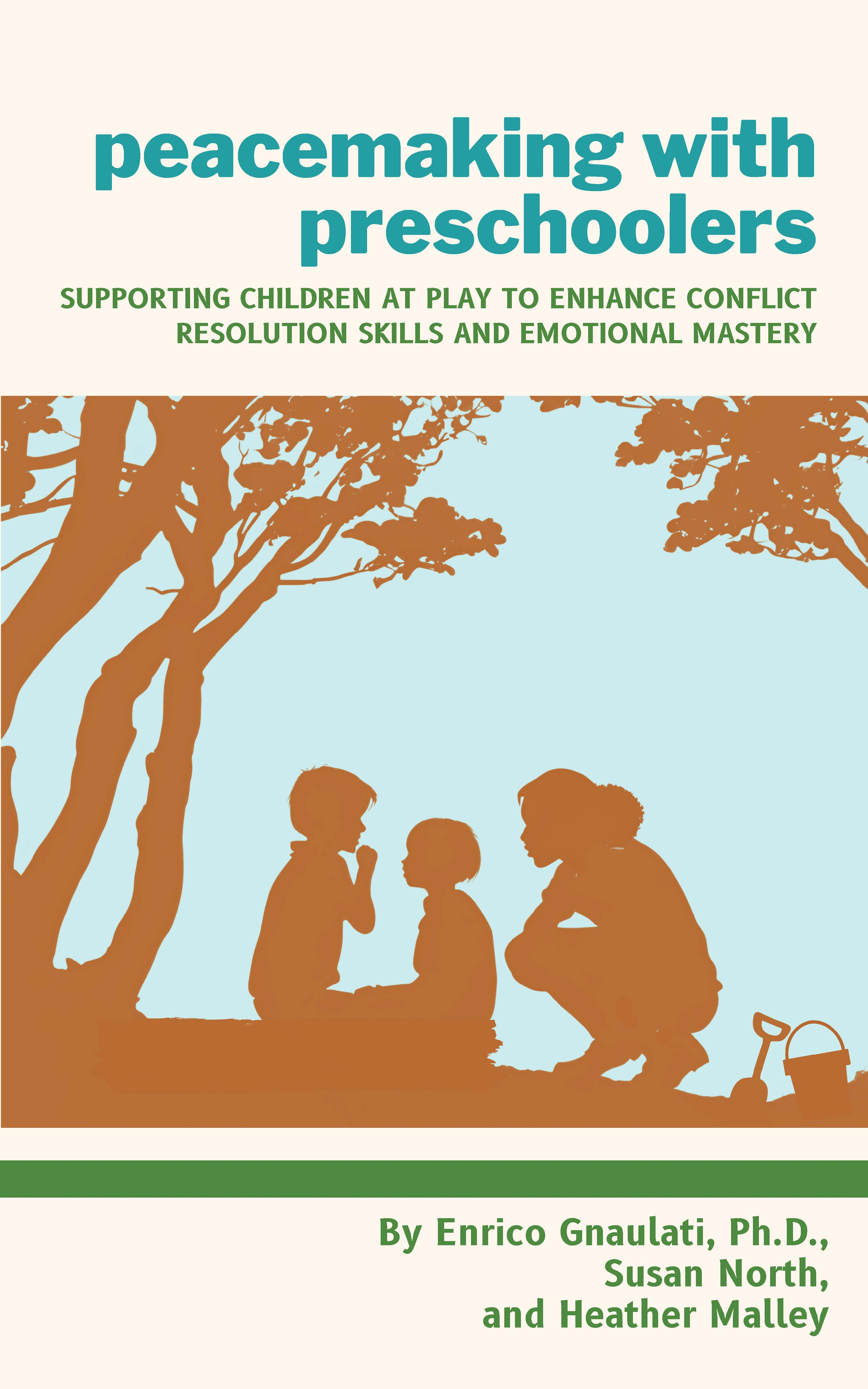
Peacemaking with Preschoolers
Supporting Children at Play to Enhance Conflict Resolution Skills and Emotional Mastery
Copyright © 2026
Supporting Children at Play to Enhance Conflict Resolution Skills and Emotional Mastery
Enrico Gnaulati (PhD), Susan North, and Heather Malley
Copyright © 2026
Conflicts in the classroom and on the playground pose a relentless challenge for teachers of young children. But these very same conflicts provide vivid, teachable moments to help advance children’s social-emotional learning, emotional regulation, self-advocacy, and empathy for peers. Mediation is the key – and it’s something not usually taught in teacher education programs.
Peacemaking with Preschoolers helps teachers learn effective, practical techniques for mediating children’s disputes. The authors provide readers with a theoretical framework – both psychological and developmental—for understanding children’s conflicts. Then they get right to the heart of the matter with scripts of actual disputes, allowing the reader a “you are there” opportunity to witness skilled teachers dealing with conflict right in the moment.
This book is built on two pillars: children need ample time for free play, and teachers need tools for handling conflicts that naturally occur. The conflicts that are bound to happen when children play with gusto and imagination are fertile ground for social and emotional learning—not an unwelcome distraction from the preschool curriculum. In short, Peacemaking with Preschoolers presents a design for classrooms where the best of what teachers have to offer in the way of mediation brings out the best of what children can learn in the way of social and emotional mastery.
Peacemaking with Preschoolers shows parents and teachers that conflict isn’t something to fear—it’s a powerful chance for children to learn kindness, patience, and problem-solving. This wonderful book turns everyday squabbles into stepping stones for lifelong friendships and resilience.
Peacemaking with Preschoolers reminds us of what children really need to thrive—learning environments that nurture healthy human relationships, prioritize hands-on creative play, and provide opportunities to acquire essential, life-long skills for peacefully resolving conflict. An important read for early childhood teachers, administrators, and policy makers.
Peacemaking with Preschoolers challenges popular myths about young children’s conflicts... It explores the over-emphasis on academic training and demonstrates the merits of play-based learning in which everyday disagreements are turned into valuable opportunities for promoting interpersonal maturity and mutual understanding. The practical guidelines contained in this volume cleverly and evocatively move us beyond Montessori, Froebel, Erikson, and Piaget to a fresh, new grasp of preschool as a developmental phase in its own right.
In today’s fast-paced, screen-saturated world, children have fewer chances to engage in the kind of spontaneous, imaginative play that builds emotional resilience and social skills. Peacemaking with Preschoolers offers a powerful, practical guide to helping young children navigate conflict through play-based learning... Whether you're a parent, teacher, or caregiver, this must-read resource will transform how you support preschoolers in becoming confident, compassionate problem-solvers.
Enrico Gnaulati Ph.D. is a clinical psychologist based in Pasadena, California, and Affiliate Professor of Psychology at Seattle University. He has published numerous journal and magazine articles, and his work has been featured on Spectrum News, Al Jazeera America, China Global Television Network, LAist (formerly KPCC) Los Angeles, KPFK, Los Angeles, KPBS, San Diego, WBUR, Boston, KPFA Berkeley, Wisconsin Public Radio, Public Radio Tulsa, and online at the Atlantic, Salon, and Psychology Today, as well as reviewed in Maclean's, Pacific Standard, The Huffington Post, The Australian, Prevention and the New Yorker. He is a blogger for Mad in America, a nationally recognized reformer of mental health practice and policy and the author of Back to Normal: Why Ordinary Childhood Behavior is Mistaken for ADHD, Bipolar Disorder, and Autism Spectrum Disorder (Beacon Press, 2013), Saving Talk Therapy: How Health Insurers, Big Pharma, and Slanted Science are Ruining Good Mental Health Care (Beacon Press, 2018) and Flourishing Love: A Secular Guide to Lasting Intimate Relationships (Karnac, 2023).
Susan North has been working with children and their families since completing UC Berkeley's Early Childhood Education program in 1971. Her professional experience includes teaching and administration for Head Start, running parent/toddler programs, and directing full-day preschools. She was a Master Teacher with LA Unified's Parent Education Division. More recently, Susie became trained in mediation and facilitation through the L.A. City Attorney's Office Dispute Resolution Program, Ken Cloke's Center for Dispute Resolution, and Centinela Youth Services. She opened her mediation practice in 2007, and has divided her time doing conflict resolution, parent education, parent coaching, blogging, teaching school-age kids to be peer mediators, and volunteering with Southern California Family Mediation in the Child Dependency Courts. She is the author of The Opposite of Combat: A Parent's Guide for Teaching Siblings How to Collaborate & Solve Their Own Conflicts (GoodMedia Press, 2019) and a contributing author to The Perfectly Imperfect Family: Real Solutions for Mindful Parents Navigating Today’s Biggest Challenges (Summit Press Publishers, 2025).
Heather Malley is Founder and Director of Caterpillar Cottage Preschool. Heather has been working in the field of early education and child development for more than 25 years. She has worked as a researcher at UCLA’s Center for Improving Child Care Quality, as an early childhood program evaluator at Child Care Resource Center, and in direct service to families and children as a preschool teacher and director. She has a B.A. in Psychology with an emphasis in Research Methods from Mills College and earned her Montessori Teaching Credential in her early years of teaching. Heather’s play-based program creates a space for preschool children which is the embodiment of empathy and active listening. It has become a preferred choice for parents. She provides mentoring for interns majoring in Child Development, as well as education for parents who seek to learn more about effective parenting. She is the author of three children’s books, Not Forever But For Now (a story about feelings during the pandemic) (Stuart Tartly Press, 2020), This Summer I Wonder (Stuart Tartly Press, 2020), and My Book - A Connection Through Empathy Journal for the Stories of a Young Child (Stuart Tartly Press, 2020).
Writing a book is a journey. Sharing it with the world should be a joy, not a technical hurdle.
I build custom, professional websites tailored specifically for authors. I offer a complete "soup-to-nuts" solution—handling everything from securing your perfect domain name to designing a beautiful layout that guides readers directly to your Amazon sales page.
You don't need to know how to code or manage servers. I work with you personally to create a digital home for your work that reflects your unique voice.
Ready to get started?
Email me: stevewil@gmail.com
View my portfolio: https://stevewil.link
Complimentary ebook and paperback copies are available to educators, journalists, media specialists and public policy representatives whose mission is to assign or promote the book. Copies are not to be redistributed.
Please drop us a line at contact@peacemakingwithpreschoolers.com to receive your complimentary copy.